South Loop Transit Projects: What Condo Sellers Should Know
How do Chicago transit projects affect South Loop home values and buyer interest?
Two projects are driving the conversation. The CTA Red Line Extension is under construction with a signed federal funding agreement, and service is targeted for 2030. A proposed Central Connector bus line went public in July 2026. Neither runs today. Both change how buyers think about the South Loop.
THE SHORT ANSWER
The CTA Red Line Extension is under construction and targeted for 2030 service, and the proposed Central Connector is a July 2026 community pitch, not a funded CTA project. Neither improves your commute today. Both signal that Chicago is investing in the transit corridors feeding the South Loop, and sellers who describe them accurately gain credibility with buyers instead of losing it.
What Is Actually Happening With Chicago Transit Right Now?
Here is the honest breakdown. One project is real and funded. One is an idea with momentum.
Know the difference. Buyers will.
The CTA Red Line Extension: Under Construction, Opening 2030
This is the largest capital project in CTA history.
The extension runs 5.5 miles south from the 95th Street terminal to 130th Street. Four new fully accessible stations. Near 103rd Street, 111th Street, Michigan Avenue around 116th Street, and 130th Street. A new rail yard near 120th Street.
Total cost is roughly $5.7 billion, with more than $1.9 billion coming from a federal funding agreement signed in January 2025. Officials broke ground on April 24, 2026, at the future Michigan Avenue station site in Roseland.
The timeline matters. Demolition and utility relocation run through 2027. Track and station construction continues through 2029. Service opens in 2030.
Now, those stations are nowhere near the South Loop. This is a Far South Side project.
So why does it matter to you?
Because of what happens to commuters. CBS Chicago reports the extension is expected to cut up to roughly 30 minutes off Far South Side commute times by eliminating the bus-to-train transfer. When that one-seat ride opens, thousands of households gain options they did not have before. Some of them start looking at Downtown Chicago condos as the logical landing spot between a downtown job and a stronger southern rail network.
That is a demand story. Not a today story. Say it that way.
The Proposed Central Connector: A Community Pitch With Real Backing
In July 2026, South Loop Neighbors went public with a proposal called the Central Connector.
Here is what it would be. A CTA bus line running in a dedicated, fully separated right-of-way, spanning 4.2 miles from Ogilvie Transportation Center in West Loop Gate, south along Canal and Clinton into the South Loop, then east on Roosevelt Road to the Museum Campus. Proposed stops include Ogilvie, Union Station, Clinton, Canal Street, Taylor Street, The 78, Roosevelt Station, and Museum Campus. An alternate routing would run down the McCormick busway toward McCormick Place and the former Michael Reese site.
The organizers say it could be built using existing street infrastructure, leaving traffic and bike lanes alone.
Now here is the part sellers must get right.
As of July 30, 2026, this is a proposal. Not approved. Not funded. Ald. Pat Dowell told Block Club Chicago the idea warrants a professional analysis of technical and financial feasibility. That is a fair, measured response, and it tells you exactly where the project stands.
So what does the proposal actually prove? That local stakeholders see rising transit demand between the West Loop, the South Loop, and the Museum Campus as real and growing. The pitch exists because development pressure in that corridor is already real.
That context belongs in your listing story. The certainty does not.
What Does the South Loop Already Have?
Before you lean on the future, ground buyers in the present.
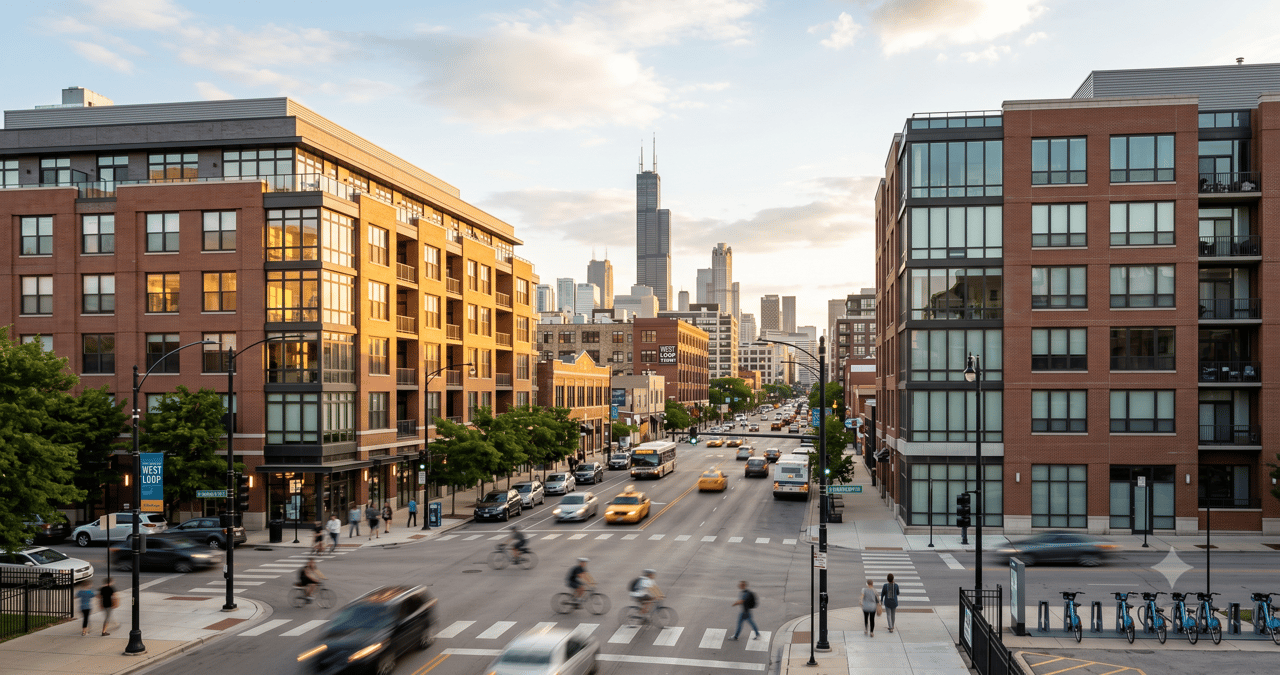
The South Loop sits on one of the strongest transit intersections in Chicago:
- Roosevelt Station. The Red, Green, and Orange Lines all converge here. Three lines, one stop.
- Loop access. The full downtown rail network is a short ride or a walk north.
- Metra proximity. Union Station and Ogilvie sit just north and west, which matters for suburban commuters and hybrid schedules.
- Museum Campus and lakefront. Walkable cultural access that buyers in most cities pay a premium to get near.
- Campus access. Columbia College and Roosevelt University are right there.
Notice something about the proposed Central Connector route? It connects nodes that are already busy. Ogilvie. Union Station. Roosevelt. Museum Campus.
That is not a coincidence. Planners follow demand. Demand is already here.
The Data: How the South Loop Compares Right Now
Trailing 90-day figures from Zillow, as of August 2026:
Area | Median Sale Price | Median Days on Market |
|---|---|---|
River North | $390,000 | 40 |
South Loop | $395,000 | 54 |
Streeterville | $487,500 | 18 |
Lincoln Park | $775,000 | 45 |
Read that days-on-market column again.
Fifty-four days in the South Loop. Compare that to 18 in Streeterville. That gap is not a knock on the neighborhood. It is a signal about positioning.
When a market moves slower, marketing carries more weight. Not less. Transit access is one of the sharpest positioning tools available to a South Loop seller, especially when you tie it to a credible forward-looking story instead of a vague claim.
How Should You Use Transit in Your Listing Strategy?
Three rules. Follow them and your transit narrative works. Break them and it backfires.
1. Separate What Is Real From What Is Proposed
The Red Line Extension is under construction. Federal funding agreement signed. Groundbreaking held. Opening year announced.
The Central Connector is a community proposal from July 2026.
Buyers do due diligence. So do their attorneys. Accuracy builds trust. Overstatement destroys it. Usually right when you need it most, during negotiation.
2. Know Whether Your Specific Address Benefits
Not every South Loop building gains equally.
Units near Roosevelt Station, along Canal or Clinton, or close to the McCormick busway corridor are best positioned to benefit from both the existing network and the proposed connector routing. If your unit sits within walking distance of Roosevelt or along that corridor that is a specific, defensible selling point with an address attached to it.
"The South Loop has good transit" is a sentence buyers ignore.
"You can walk to Roosevelt and be on three rail lines in under ten minutes" is a sentence buyers remember.
3. Answer the Construction Question Before It Is Asked
Some buyers will ask whether ongoing CTA capital work affects noise, traffic, or access.
Give them the real answer. Construction impacts tend to be temporary and corridor-specific. Accessibility gains tend to be durable. Put that in your marketing rather than waiting for it to surface during inspection negotiations.
Get ahead of the question. Keep the conversation on your terms.
What About Illinois Disclosure Requirements?
Transit narrative is marketing. Your disclosure package is the legal foundation of the sale. Do not confuse the two.
Under the Illinois Residential Real Property Disclosure Act, sellers of most one-to-four-unit residential properties, including condos, must complete a Residential Real Property Disclosure Report covering known material defects. Your listing broker and attorney handle this.
For buildings constructed before 1978, federal law requires a Lead-Based Paint Disclosure, including the EPA pamphlet and documentation of known hazards. Many South Loop buildings are newer. Converted lofts and older structures may not be. Know your year built.
Radon forms and educational materials are common in Chicago-area contracts. Buyers often request testing, especially for ground-level and garden units, and may negotiate remediation. Expect that conversation.
For larger multifamily and mixed-use South Loop buildings, Chicago's Energy Benchmarking and Disclosure Ordinance may apply at the building level, and that data can surface in association documents during due diligence.
Chicago condo closings are attorney-centric. Once a contract is signed, both sides engage attorneys who manage the attorney review period, inspection contingencies, association document review, and closing. Declarations, bylaws, budgets, and meeting minutes all get examined.
That is the norm here. Plan for it.
Key Takeaways
- The CTA Red Line Extension is real, funded, and under construction, with service targeted for 2030 and four new Far South Side stations.
- The proposed Central Connector bus line is a July 2026 community proposal from South Loop Neighbors, not an approved or funded CTA project.
- Neither project changes South Loop transit service today, so frame both as forward-looking demand drivers.
- Location within the South Loop determines how much of the transit story actually applies to your unit.
- Your disclosure package, not your marketing narrative, is the legal backbone of the sale.
Frequently Asked Questions
How will the CTA Red Line Extension affect South Loop property values if the new stations are far south of downtown?
The stations are on the Far South Side, not in the South Loop. The effect is indirect. By giving Far South Side residents a faster one-seat ride downtown, the extension is expected to widen the pool of buyers who see transit-rich downtown neighborhoods as viable. CBS Chicago reports projected commute savings of up to roughly 30 minutes. Service is targeted for 2030.
Is the proposed Central Connector bus line through the South Loop actually happening?
As of July 30, 2026, it is a community proposal, not an approved or funded CTA project. South Loop Neighbors described a 4.2-mile dedicated bus route connecting Ogilvie, Union Station, the South Loop, and Museum Campus. Ald. Pat Dowell said the idea warrants professional feasibility analysis. Present it as a proposal, never as a confirmed line.
What transit improvements are coming to Chicago by 2030 that South Loop sellers should mention?
The Red Line Extension is the credible one. Construction began with a groundbreaking on April 24, 2026. Four new stations are planned. Service is targeted for 2030. The Central Connector is worth mentioning as context for growing corridor demand. Frame both as future or proposed.
Does living near Roosevelt Station or the Museum Campus change buyer demand for South Loop units?
Yes. Roosevelt Station is where the Red, Green, and Orange Lines converge, which is a genuine advantage for buyers commuting to the Loop, West Loop, or Midway. Museum Campus and McCormick Place access matters to buyers who want walkable cultural amenities and less car dependence.
Are buyers worried about construction impacts from transit projects in the South Loop?
Some ask, particularly about units near active rail corridors or busways. Construction impacts are typically short-term and corridor-specific. Accessibility gains tend to be durable. Address it in your marketing rather than during inspection negotiations.
The Bottom Line for South Loop Sellers
The South Loop sits between two of Chicago's strongest demand generators. The West Loop office core to the northwest. The Museum Campus lakefront to the east. The transit investment moving through the city over the next several years reinforces that position rather than creating it.
Your job as a seller is not to oversell the future. It is to describe it accurately and then connect it to your specific building, your specific block, and your specific price. General neighborhood stories do not sell condos. Address-level strategy does.
Get the story right and buyers trust everything else you tell them.
Ready to Talk About Your Unit?
Call or text Christine Hancock at 312-296-9300 to talk about your unit's value, or what it would take to get you to the closing table.
ABOUT THE AUTHOR
Christine Hancock is a Chicago Realtor with @properties Christie's International Real Estate, bringing more than 25 years of experience and over $200 million in closed sales in the downtown condo market. With 97 five-star Zillow reviews, Christine is recognized for her commitment to client satisfaction and market expertise.
She specializes in high-rise and luxury condominium sales in West Loop, South Loop, River North, and Streeterville, helping buyers and sellers navigate complex transactions with data-driven pricing strategies and deep neighborhood insight.
Christine partners with clients to evaluate market trends, position properties competitively, and make confident, informed decisions in Chicago's vibrant downtown housing market.