How do I figure out my net proceeds when I sell my Downtown Chicago condo?
THE SHORT ANSWER
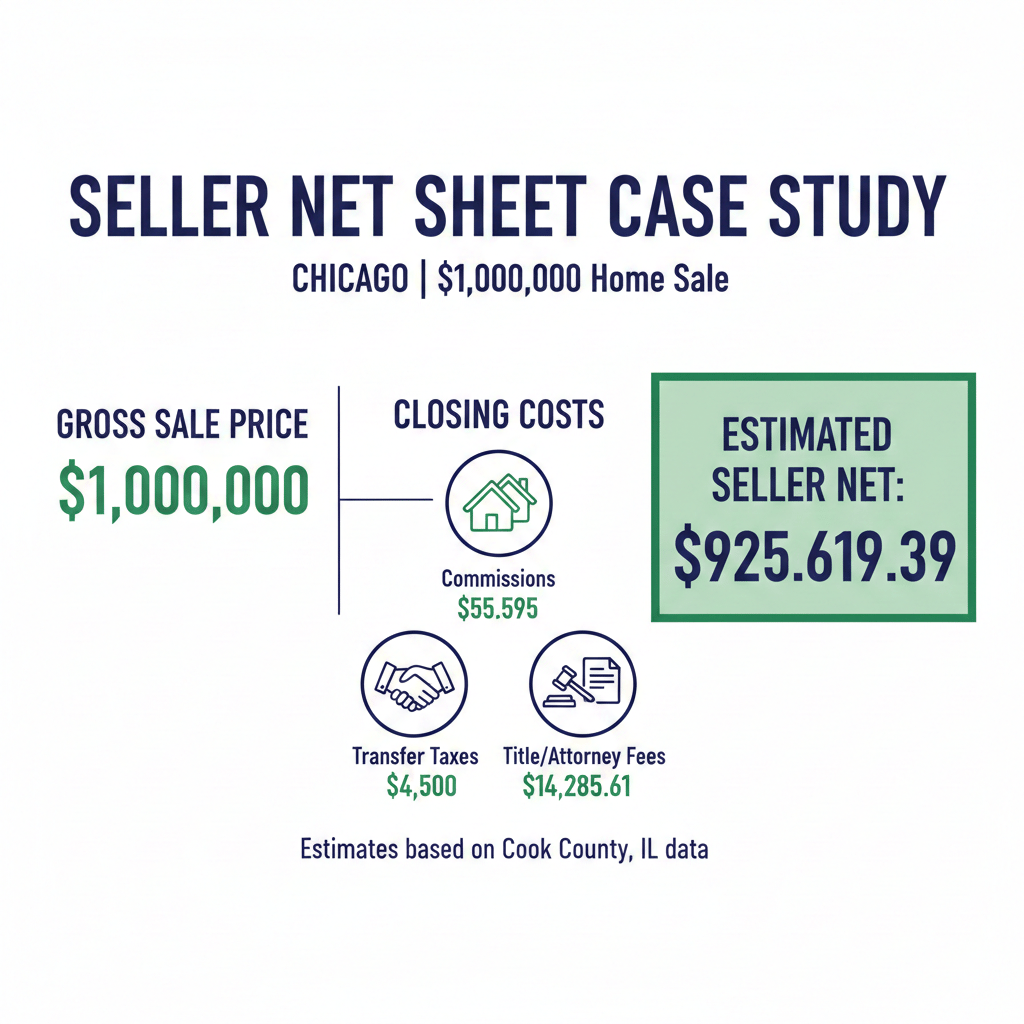
Your net proceeds from selling a Downtown Chicago condo equal your sale price minus mortgage payoffs, brokerage fees, transfer taxes, attorney fees, title charges, property tax credits, and condo association costs. Every category is negotiable except statutory transfer tax rates, so your actual number depends on your contract terms, debt situation, and closing date. The only way to know your real number is to run a personalized net sheet with someone who knows this market.
What actually comes off your sale price, and what's negotiable
Every seller I work with in the West Loop, River North, and Streeterville asks the same question the moment we start talking strategy: "What will I actually walk away with?" It's the right question to lead with. Here's how I walk my clients through it.
Your settlement statement, typically an ALTA-style closing statement, lists every credit and debit on your side of the transaction. The CFPB's closing cost overview identifies the standard seller-side categories nationally, but Downtown Chicago condos have a specific local layer on top of that. Let's go through each one.
Mortgage and lien payoffs
This is usually the single largest debit. Your lender issues a payoff letter good through a specific date. Miss that date and the figure changes. Your attorney coordinates this directly with the title company so the wire is exact.
If you have a home equity line of credit on the unit, that gets paid off at closing too. The impact on your net is entirely specific to your own debt situation.
Brokerage compensation
Broker fees are fully negotiable and not set by law. There is no standard, typical, or customary rate. The listing-side fee is agreed in your listing agreement with your brokerage. Any compensation a seller chooses to offer a buyer's agent is optional and separately negotiable; the seller is not automatically required to cover it, and it is not shared on the MLS. If you want to understand what brokerage compensation would look like for your specific situation, that's a conversation to have directly with me, not something to estimate from a blog post.
Transfer taxes, the fixed-rate layer
This is where Downtown Chicago sellers are often surprised, because there are three separate transfer taxes that apply to a Chicago condo sale, each set by a different governmental body.
Tax | Rate | Levied by | Who pays? |
|---|---|---|---|
City of Chicago Real Property Transfer Tax | $3.00 per $1000 of price | City of Chicago | Seller |
Cook County Real Estate Transfer Tax | $0.50 per $1000 of price | Cook County | Seller |
Illinois State Real Estate Transfer Tax | $1,000 per $1000 of price | State of Illinois | Seller |
The rates themselves are fixed by statute. The City of Chicago Department of Finance administers the city-level tax; the Cook County Recorder of Deeds handles the county tax; and the state rate is set under 35 ILCS 200/31-10. What is not fixed is who pays. That's a contractual negotiation between buyer and seller. Per the City's own materials, the tax statute does not dictate which party bears the cost. Your attorney will address this during the attorney review period.
Illinois law also requires that transfer taxes be paid at the time the deed is presented for recording. That timing is non-negotiable, per 35 ILCS 200/31-15.
Attorney fees
Illinois is an attorney-review state. The Illinois State Bar Association notes that residential purchase contracts in the Chicago area routinely include an attorney review clause, typically a short window after signing during which each side's attorney can approve, reject, or modify the contract. Your attorney also reviews disclosure documents, coordinates the title commitment, obtains mortgage payoff letters, reviews condo association documents, and attends closing. Attorney fees are set by your engagement agreement with your own attorney and are not standardized.
Title and settlement charges
A title company issues a title commitment identifying all liens, mortgages, and encumbrances against your unit. Title insurance premiums (for the owner's policy and any lender's policy), the title search, the closing/settlement fee, and related administrative charges all appear as line items. Per the NAR's seller closing guidance, who pays which title components is often dictated by local custom and negotiated in the contract. Your attorney handles this during attorney review.
Cook County property tax credit
This one catches a lot of sellers off guard. Cook County property taxes are billed one year in arrears, meaning your 2025 tax bill is typically issued and paid in 2026. At closing, you'll give the buyer a credit for your share of the current year's taxes (from January 1 through your closing date), because that bill won't arrive until after you've already sold the unit. The Cook County Treasurer notes that taxes are paid in two installments, with the first installment based on 55% of the prior year's total, so the proration is typically calculated using the prior year's bill and an agreed multiplier or assumption. The exact method is contractual and negotiable.
In my experience, this credit is one of the most misunderstood line items on a Downtown Chicago settlement statement. Sellers sometimes see it as money they're "losing." It's really just your fair share of the tax for the period you owned the unit.
Condo association items
Under the Illinois Condominium Property Act, 765 ILCS 605/22.1, your association is required to provide key documents to prospective purchasers: declaration and bylaws, rules and regulations, current budget, financial statements, and meeting minutes. A paid assessment letter (sometimes called an assessment status letter) confirms you're current on monthly assessments and identifies any outstanding amounts or special assessments. Any unpaid regular or special assessments must be satisfied or credited at closing. Fees for pulling these documents are commonly charged by the association or management company; whether buyer or seller pays is typically negotiated in the contract.
If your building has a pending or recently levied special assessment, that will affect your net. It's something I always flag early in the listing process so there are no surprises at closing. For a deeper look at how association fees factor into the full cost picture, see my post on the true cost of selling a Chicago condo.
Other negotiated debits
Your settlement statement may also include credits to the buyer for agreed repairs or inspection items, a home warranty if you offered one, or prorated utility charges. These are entirely deal-specific and flow directly from what was negotiated in the contract and attorney review period.
Required disclosures, what you have to provide
Disclosures don't directly reduce your net proceeds, but gaps in compliance can create post-closing liability or derail a deal. Here's what Downtown Chicago condo sellers are required to provide:
- Residential Real Property Disclosure Report: Required under the Illinois Residential Real Property Disclosure Act (765 ILCS 77/) for residential properties of 1 to 4 units. You disclose known material defects in the property's physical condition, using the statutory form, before the buyer is obligated under any contract.
- Lead-Based Paint Disclosure: Required for any unit in a building constructed before 1978, under the Residential Lead-Based Paint Hazard Reduction Act. You provide the standardized disclosure form plus the EPA pamphlet "Protect Your Family from Lead in Your Home" before contract execution. The HUD enforcement page confirms this applies to Downtown Chicago condos in pre-1978 buildings.
- Radon Awareness: The Illinois Radon Awareness Act requires that sellers provide the state radon brochure. Many Chicago-area contracts also include a radon testing contingency. The Illinois Emergency Management Agency strongly recommends testing, and buyers often negotiate it.
- Energy Benchmarking Information: Many Downtown high-rise condo buildings are subject to the City of Chicago Energy Benchmarking Ordinance, which requires annual energy usage reporting. Building energy scores may be shared as part of the association document package. This is a city requirement on the building, not a state-mandated individual seller disclosure, but buyers in affected buildings often ask about it.
Your listing broker, registered with the Illinois Department of Financial and Professional Regulation, will walk you through the required forms. Your attorney reviews them during the attorney review period.
Building your real net sheet, why a local analysis matters
Here's what I tell every seller who asks me this: a net sheet is only as good as the inputs. Citywide or national averages won't tell you what your unit in a South Loop high-rise or a Gold Coast vintage building will actually net. Neighborhood-level data matters far more than broad market figures.
The most recent market context available, from Q2 2025 data compiled by Zillow Research, shows continued active condo sales across Chicago's central neighborhoods, Loop, Near North Side, River North, Streeterville, with median listing prices notably above citywide medians. That's useful context, but it's portal-level data, not a substitute for a current comparative market analysis on your specific unit. As of mid-2026, market conditions have continued to evolve, and the only way to know where your unit sits is to run the numbers with someone who's pricing and selling condos in these buildings right now.
I believe sellers deserve full transparency into the numbers behind every pricing recommendation. Before we ever go to market, I build a detailed net sheet for every client, line by line, based on your actual payoff, your building's association status, your closing timeline, and current transfer tax allocations in recent comparable contracts. That's the conversation that sets the strategy.
If you want to understand how pricing decisions connect to net proceeds, my post on pricing a Downtown Chicago condo to attract serious buyers walks through how I approach that analysis.
Frequently Asked Questions
What closing costs should I expect as a seller in a Chicago high-rise condo building?
As a Downtown Chicago condo seller, your side of the settlement statement typically includes brokerage compensation (per your listing agreement), transfer taxes at the City, County, and State levels, attorney fees, title and settlement charges, a Cook County property tax credit to the buyer, and condo association items including any unpaid assessments and document fees. Mortgage and lien payoffs are usually the largest single debit. Most of these are negotiable in your contract. Only the statutory transfer tax rates are fixed by law.
Who usually pays the City of Chicago and Cook County transfer taxes when I sell my condo, and is that negotiable?
The transfer tax rates are fixed by statute. The City of Chicago imposes $3.75 per $500 of price (per the Chicago Department of Finance), Cook County imposes $0.50 per $500 (per the Cook County Recorder), and Illinois imposes $0.50 per $500 under 35 ILCS 200/31-10. Who actually pays each tax is negotiable between buyer and seller. It's addressed in your purchase contract and can be modified during attorney review. Never assume the allocation without confirming it in your own contract.
How are property taxes prorated or credited at closing for condos in Cook County?
Cook County taxes are billed one year in arrears, so at closing you'll typically give the buyer a credit covering your share of the current year's taxes from January 1 through your closing date. The Cook County Treasurer notes that the first installment is based on 55% of the prior year's total, so prorations are usually calculated using the prior year's bill and an agreed multiplier. The exact method, including whether a tax-increase multiplier applies, is contractual and negotiated between the parties.
Do I need an attorney to sell my condo in Downtown Chicago, and what do they do?
Illinois is an attorney-review state, and in the Chicago condo market, attorney involvement is standard practice, not optional. Per the Illinois State Bar Association, your attorney reviews and can modify the purchase contract during the attorney review period, coordinates the title commitment and mortgage payoffs, reviews condo association documents, and attends closing. For a condo specifically, they also review the association's financial documents and flag any issues with special assessments or pending litigation that could affect your net.
How do HOA fees, special assessments, and unpaid balances affect my net when I sell?
Any unpaid regular assessments or special assessments must be paid off or credited at closing. They're identified in the paid assessment letter your association provides under 765 ILCS 605/22.1. A pending or recently levied special assessment can meaningfully reduce your net proceeds, which is why I always pull the association's financial status early in the listing process. Fees for the condo document package are a separate line item and are typically negotiated as to who pays in the purchase contract.
What disclosures are required when selling a condo in Chicago?
You're required to provide a Residential Real Property Disclosure Report under the Illinois Residential Real Property Disclosure Act, a Lead-Based Paint Disclosure for any building built before 1978 (per federal HUD/EPA rules), and radon awareness materials under the Illinois Radon Awareness Act. For units in larger buildings covered by Chicago's Energy Benchmarking Ordinance, building energy scores are typically shared as part of the association document package. Your broker and attorney will ensure you're covered on all required forms before the buyer is obligated under contract.
Your net proceeds from selling a Downtown Chicago condo are the product of dozens of variables: your sale price, your payoff, your building's association status, how transfer taxes are allocated in your contract, and your closing date. The only way to know your real number is to build a personalized net sheet with someone who knows these buildings and this market.
If you're thinking about selling in the West Loop, River North, South Loop, Old Town, Streeterville, or anywhere in Downtown Chicago,
I'll walk you through the numbers line by line, before you ever sign a listing agreement.
About Christine Hancock
Christine Hancock is a seller-first real estate expert with @properties Christie's International Real Estate, helping Chicago homeowners maximize their market position through strategic preparation, data-driven pricing, and marketing that builds real demand. Her expertise centers on the West Loop, River North, South Loop, Old Town, and Streeterville, where she combines deep neighborhood insight with a proven listing strategy, and maintains a track record of successful sales throughout the entire Downtown Chicago area. Christine leads The Hancock Group at @properties. 312-296-9300
Equal Housing Opportunity. Christine Hancock is a licensed Illinois real estate broker affiliated with @properties and a member of the Chicago Association of Realtors. This article is provided for general informational purposes only and does not constitute legal, tax, or financial advice. Transfer tax rates, proration methods, and cost allocations are subject to change and vary by transaction. Readers should confirm all figures and obligations with their own attorney, tax advisor, lender, or closing officer before proceeding.