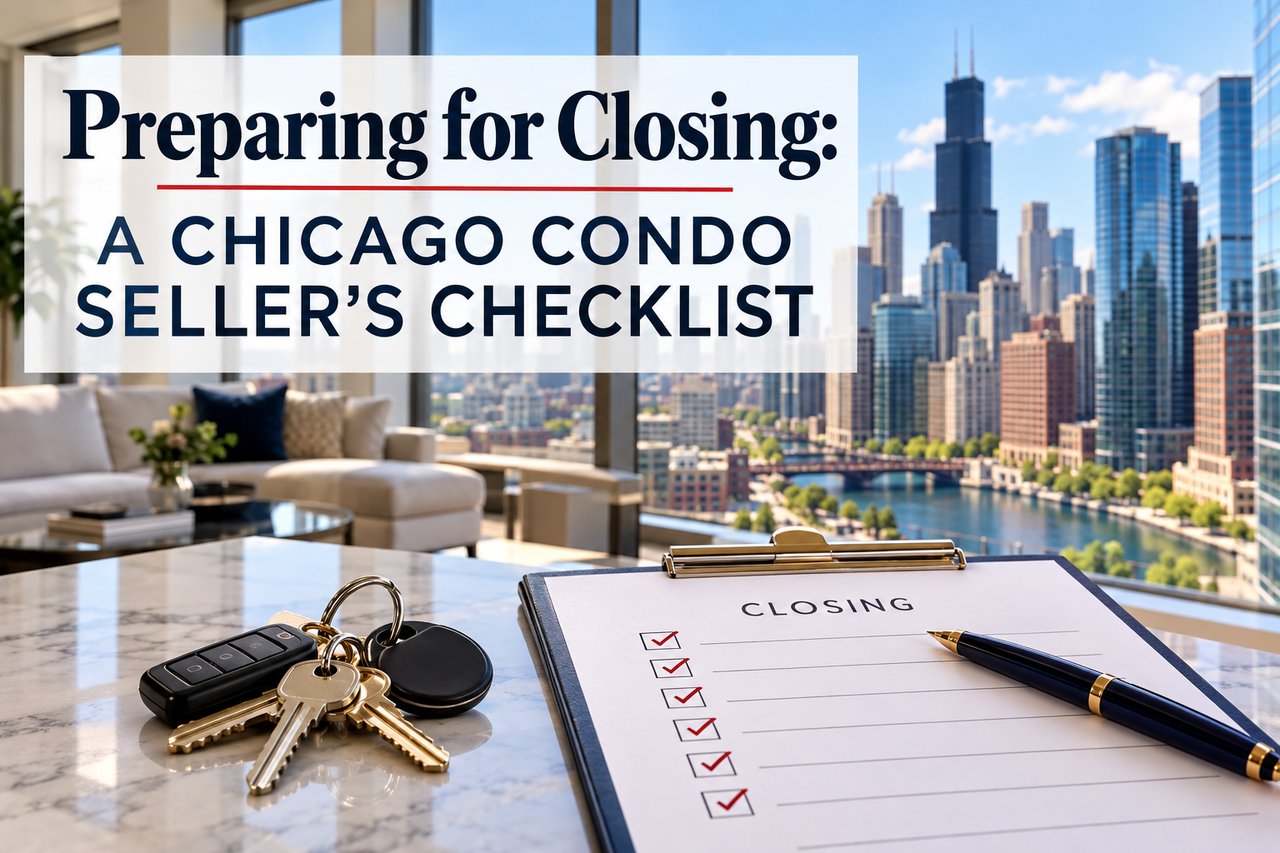
Before you list, ask your association for its fee schedule and an account statement in writing. Those two documents show what your building charges for move-out, elevator use, and the resale package, and whether anything is owed. Your real estate attorney then sorts out who pays what under the contract.
What do Downtown Chicago condo sellers pay beyond commission?
Downtown Chicago condo sellers pay beyond commission for a set of building-specific and closing-day items: the association's resale package, move-out and elevator charges, any unpaid or prorated assessments, property-tax adjustments, transfer taxes allocated by contract, and attorney and title items. The amount and the payer for most of these depend on your building's rules and your purchase contract, not on a citywide price list. The fastest way to get real numbers is to request your association's fee schedule and an account statement before you list.
Key Takeaways
- Across the wider Downtown Chicago market, 29% of homes sold August to October 2026 (all home types) went under contract within two weeks of listing, so your building paperwork should be ready before you launch.
- Illinois law lists what a condo resale package must include, including a statement of liens and the unit account showing unpaid assessments, and permits the association to charge the seller a reasonable fee capped at $375, subject to CPI adjustment.
- Move-out fees, elevator reservations, deposits, and mover-insurance rules come from your building, so two buildings a few blocks apart can handle them differently.
- A property-tax credit on the closing statement is a proration between buyer and seller, not a new tax created by the sale.
- Transfer-tax responsibility and the cost of a special assessment can both be negotiated in the contract, so your real estate attorney should review them before you sign.
What else do Downtown Chicago condo sellers pay beyond commission?
Beyond commission, expect association paperwork charges, move-out costs, assessment adjustments, tax adjustments, and professional fees at closing. Broker fees are fully negotiable and not set by law, and that conversation belongs in your listing agreement with me. The rest of the list is where surprises hide.
Here is how I sort the categories for my clients in the West Loop, River North, South Loop, Streeterville, and the rest of downtown.
Category | What it is | What sets the amount | What to request |
|---|---|---|---|
Association resale package | Association documents, including a statement of liens and the unit account | Your building's rules and management company | Written request form and fee schedule |
Move-out and elevator charges | Notice, moving window, elevator reservation, deposit, mover insurance | Your building's move-out rules | Current move-out rules and deposit policy |
Unpaid or prorated assessments | Regular assessments, late charges, and other association amounts | Association records and the contract | Written account or payoff statement |
Special assessments | Approved assessments that may not be fully billed yet | Association documents and the contract | Status of every approved assessment |
Property-tax adjustment | Credit or debit between buyer and seller at closing | Tax bills, payment status, contract language | Proration shown on the closing statement |
Transfer taxes | State, Cook County, City of Chicago, and CTA requirements | Ordinance, statute, and the contract | Your attorney's review of the contract |
Attorney, title, and payoff items | Legal review, lien releases, title-related charges | Providers and the contract | Itemized quotes from your attorney and title company |
I'm not going to put dollar amounts on this list. No one can honestly quote you a citywide number for these items, because they change by building, contract, and closing date. If you want your own numbers laid out, I'll build them with you. My post on net proceeds when selling a Downtown Chicago condo shows how I approach that conversation.
How do I find out what my building will charge me?
Ask your association or management company, in writing, for the current fee schedule, the resale package requirements, the move-out rules, and an account statement for your unit. Do it before you list, not after you accept an offer.
What does the resale package cover?
Under the Illinois Condominium Property Act, a unit owner reselling a condo must obtain specified documents from the board of managers and make them available to the buyer. That includes a statement of liens and the unit account showing unpaid assessments and other charges due.
The same law does not set one statewide price for the package. It also does not set a move-out fee, an elevator-reservation fee, or a building-document fee. Those come from your declaration, rules, board policy, and management company. The same goes for request forms, payment methods, and how long a package stays valid.
I see sellers wait until they have an accepted offer to order the package. That creates scheduling pressure you can avoid. Because the first stretch after launch is when buyers are most active, I like to have the building paperwork in hand before the listing goes live. Across the wider Downtown Chicago market, 29% of homes sold August to October 2026 (all home types) went under contract within two weeks of listing, and months of supply was 3.0, according to recent local market data. That is area-wide context, not a forecast for your unit, but it shows why slow paperwork can cost you momentum.
What should I ask about move-out and elevator rules?
Move-out requirements vary by building. Common examples include advance notice, a required moving window, an elevator reservation, a refundable damage deposit, proof of insurance from your mover, hallway or door protection, and limits on loading or parking.
Ask for the rules in writing and note which items are fees and which are refundable deposits. Then check the dates against your closing timeline. If your closing and your elevator availability do not line up, you want to find that out early, not the week of.
Why do I need a written account statement?
Request a written account or payoff statement that breaks out regular assessments, delinquent assessments, late charges, special assessments, attorney fees, lien-related amounts, move-out charges, document charges, and anything else the association expects to collect. Your real estate attorney can then confirm which items are yours under the contract.
Unpaid assessments matter because they can affect closing. Late charges and approved special assessments may need to be paid or resolved before or at closing, subject to your governing documents and applicable law. The exact payoff figure should come from the association or its management company. If you want context on regular monthly charges, my breakdown of Downtown Chicago condo fees covers what they usually include.
What about a special assessment that is approved but not fully billed?
This is a contract question. The parties can negotiate whether the seller pays it, gives the buyer a credit, or hands responsibility to the buyer. Your association's documents and your purchase contract control the result, not a general Chicago custom. Find out the status early so you are not negotiating it under pressure.
How do property taxes, transfer taxes, and assessments show up at closing?
They show up as line items and adjustments on the closing statement, and your real estate attorney handles the closing and walks you through each one. Some are credits or debits between you and the buyer. Others are taxes whose payer is set by the contract.
How do property-tax credits work?
Property taxes are commonly adjusted between buyer and seller at closing. A credit or debit on your statement changes your proceeds, but it is not a new tax created because you sold. What drives it is whether the current bill has been paid, which tax period is being prorated, and what proration method your contract uses. The Cook County Treasurer issues the tax bills, so have your latest bill handy when your attorney reviews the contract.
Which transfer taxes apply, and who pays?
Illinois, Cook County, the City of Chicago, and the Chicago Transit Authority each impose transfer-tax requirements on qualifying transfers. The party legally responsible for a particular stamp can differ from the party who bears the cost under the contract. Do not rely on what a neighbor in your building says is customary. Have your attorney confirm the allocation against the City of Chicago, Cook County Clerk, and Illinois Department of Revenue requirements for your closing date.
What are the other payoff and professional items?
Expect attorney fees, title-related charges, and payoff or lien-release items. Negotiated buyer credits also reduce your proceeds. Ask your attorney and title company for itemized figures instead of a rule of thumb. My post on why Downtown Chicago sellers see higher closing costs goes deeper on the bigger-ticket items.
What should I do before I list my condo?
Gather your building's paperwork first, then price and plan around real numbers. Here is the order I use with my clients.
- Request the fee schedule. Ask for the resale package requirements, move-out rules, elevator process, deposit policy, and mover-insurance requirements.
- Get a written account statement. Ask that it list every amount the association expects to collect.
- Check special assessments. Confirm anything approved but not yet fully billed.
- Pull your latest property-tax bill. Your attorney needs it to review the proration language.
- Talk to your attorney early. Have them review who pays what before you accept an offer.
- Build your own net figures with me. I will help you plan around your building's actual charges.
For market context, the Illinois REALTORS® October 2026 City of Chicago report counted 1,612 closed sales across all property types citywide, down 11.7% from October 2025. That report is not a Downtown Chicago condo-only series, so treat it as a backdrop, not a pricing guide. For pricing, the right comparison is your building and your line. My post on pricing a Downtown Chicago condo to attract serious buyers explains how I approach that.
FAQ
What fees do Chicago condo sellers pay besides the listing commission?
Sellers commonly deal with the association's resale package, move-out and elevator charges, unpaid or prorated assessments, property-tax adjustments, transfer taxes as allocated by the contract, and attorney and title items. The amounts depend on your building and contract. I help my clients get the building's fee schedule early so nothing surprises them at closing.
Who pays the condo resale package fee in Chicago?
Illinois law requires the unit owner to obtain the specified association documents for the buyer, so the request usually starts with you. The statute does not set a price or say who ultimately bears the cost. Check your building's request form and your purchase contract, and have your attorney confirm.
Can unpaid HOA assessments stop a Chicago condo sale?
Unpaid assessments, late charges, and approved special assessments may need to be paid or resolved before or at closing, subject to your governing documents and applicable law. The association or its management company provides the exact payoff figure. Order an account statement early so you can clear anything outstanding before it becomes a closing-week problem.
Who pays the move-out fee and elevator reservation fee in a Chicago condo building?
The building sets these charges, and they are not uniform across Chicago. A seller usually coordinates the move, so ask for the current fee schedule and deposit policy in writing. If your contract addresses move-out responsibilities, your attorney can confirm who owes what.
Can a condo building charge a move-out deposit or require mover insurance?
Many Chicago-area buildings do, based on their own rules. Common requirements include a refundable damage deposit, proof of insurance from the mover, hallway or door protection, and a reserved moving window. Your building's current rules control, so request them before you schedule movers.
Get your building's numbers before you list
What condo sellers pay beyond commission comes down to your building's paperwork and your contract. Get the fee schedule and account statement early, and have your attorney review the rest. If you'd like help gathering those documents and planning around them, schedule a consultation with me. You may also like 10 questions Downtown Chicago condo sellers ask first.
Equal Housing Opportunity. Christine Hancock, Broker Associate, licensed in Illinois and regulated by the Illinois Department of Financial and Professional Regulation. This article is general information, not legal, tax, or financial advice. Confirm your own numbers with your real estate attorney, tax advisor, or lender.